
 by admin
Medina Azahara, a palace city that stands as a testament to the grandeur of the Umayyad caliphate, is famous not only for its monumental scale and history but also for its decorative art. Among its countless details, the stucco and ataurique work of the Salón Rico stands out for a visual language that invites us to decode it. In this article we dive into the meaning and importance of these artistic elements and explore how they reflect the culture and spirituality of the time.
History of the Salón Rico
Located within the Medina Azahara complex, the Salón Rico was one of the palace’s main halls. It served not only as a reception room for dignitaries but also as a space for important political and cultural events. Its lavish, opulent decoration was designed to astonish anyone who crossed its threshold.
Function and symbolism
The Salón Rico symbolised the power and wealth of the caliphate. The opulence of its decoration mirrored the prestige of the ruler and his wish to proclaim the greatness of his regime. Through its stucco work, the aim was not only to impress but also to convey a deep message about the political and spiritual vision of the time.
The art of stucco
Stucco is a form of decorative plaster widely used in Islamic architecture of the period. At Medina Azahara, this stucco is charged with meaning, turning the walls into a means of visual communication that transcends time.
Decorative elements
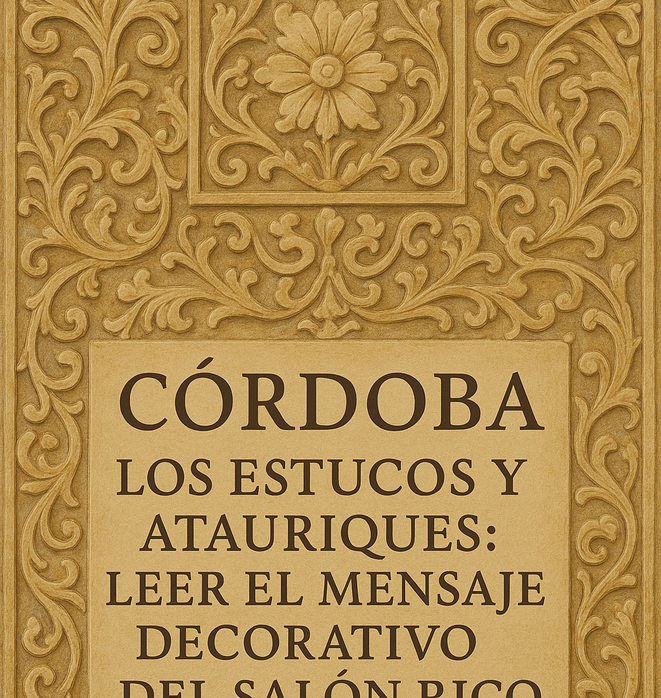
The decorative motifs in the stucco of the Salón Rico include a variety of geometric shapes, plant forms and calligraphy. These elements are not mere ornaments: every figure and every curve carries a meaning deeply rooted in the Islamic worldview.
The ataurique technique
Ataurique is a specific type of relief decoration characterised by its intricate plant-based designs. In the Salón Rico, ataurique is not only a visual delight but also expresses ideas of order and harmony, reflecting the search for beauty in all of creation.
Interpreting the decorative messages
Studying the stucco and ataurique work takes us into a world of symbols and hidden messages. The combination of geometric and plant motifs, together with calligraphic inscriptions, suggests a profound respect for nature and the divine.
Sacred geometry
Geometry in the decoration reflects a universal principle that runs through not only art but also architecture and spirituality. The repetition and symmetry of the stucco invite reflection on the order of the universe.
Calligraphy as a vehicle of communication
The inscriptions accompanying the decorative designs carry messages that speak to spirituality as well as to the history of the caliphate. They often feature verses from the Qur’an or phrases glorifying the ruler, underlining his connection with the divine.
Tips for your visit
If you are planning to visit Medina Azahara and marvel at the stucco and ataurique of the Salón Rico, here are a few tips:
- Check opening times and book your place in advance.
- Wear comfortable shoes, as you will be walking on uneven paths.
- Bring a guidebook or a mobile device with information about the site to enrich your visit.
- Don’t forget your camera: the beauty of the stucco work deserves to be captured.
Frequently asked questions
Is the Salón Rico accessible for people with reduced mobility?
Yes, the site has facilities for people with reduced mobility so that everyone can enjoy its beauty.
Are guided tours available in different languages?
Yes, there are guided tours in several languages that help you better understand the historical and artistic context.
How much time should I allow for a visit to Medina Azahara?
We suggest at least three hours to properly explore the site and each of its spaces.
What is the best time of year to visit?
Spring and autumn are the best seasons, thanks to the mild weather and the natural beauty surrounding the site.
Conclusion
The stucco and ataurique of the Salón Rico at Medina Azahara are much more than ornaments: they carry a cultural heritage that speaks of an age of splendour and sophistication. We invite you to discover this legacy at Medina Azahara and let its beauty tell you stories through its shapes and details. Book your guided tour today so you don’t miss this opportunity.


