
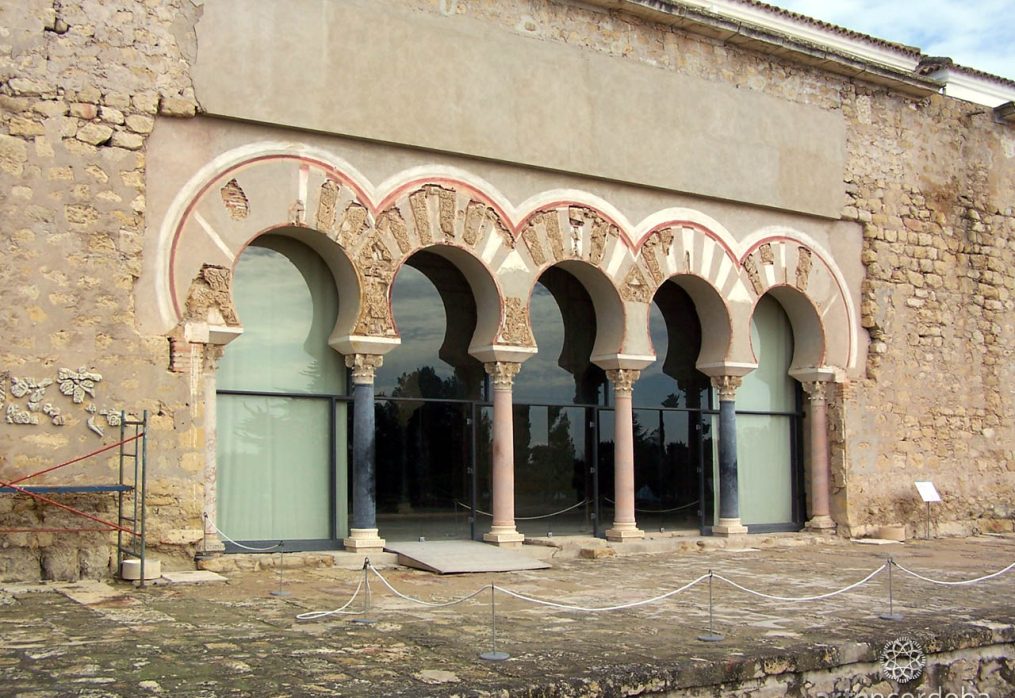
 by admin
To talk about Medina Azahara is to talk about Abd al-Rahman III, the man who dreamed it up and ordered it built. Grandson of an emir, left fatherless a few weeks after his birth and on the throne at just twenty-one, Abd al-Rahman III turned an emirate torn apart by rebellions into the most powerful state in Western Europe and made Córdoba the capital of a caliphate.
In this article we do not focus on the palace city itself but on its founder: who he was, how he came to power and why he decided to build a brand-new city at the foot of the Sierra Morena.
Who was Abd al-Rahman III: the origins of an unexpected emir
Abd al-Rahman ibn Muhammad was born in Córdoba in 891 into the Umayyad dynasty, which had ruled al-Andalus since 756. His father, Muhammad, was one of the sons of Emir Abd Allah, but he was murdered when the boy was still a baby. The child was raised at the palace under the protection of his grandfather, who eventually chose him as his successor ahead of his own sons.
His family tree reflects the mixed nature of the Córdoba court: his mother, Muzna, was a concubine of Christian origin, and his paternal grandmother, Onneca, was a Navarrese princess. Chroniclers say the future caliph had fair skin, blue eyes and reddish hair, which he dyed dark to look more like the traditional image of an Arab ruler.
An emirate on the brink of collapse
When Abd al-Rahman III came to the throne in October 912, Córdoba’s authority barely reached beyond the city and its surroundings. Local lords were in revolt all over al-Andalus, and the most dangerous of them was Umar ibn Hafsun, who held out in the fortress of Bobastro in the mountains of Málaga. The young emir spent his first fifteen years subduing the rebels one by one, until Bobastro, the last major stronghold, fell in 928.
From emir to caliph: the proclamation of 929
On 16 January 929, Abd al-Rahman III took an unprecedented step in the history of al-Andalus: he proclaimed himself caliph, commander of the faithful, and adopted the title al-Nasir li-din Allah, “he who fights victoriously for the religion of God”. With that gesture he stopped recognising any religious authority above his own.
The decision made clear political sense. In North Africa the Fatimids had proclaimed their own caliphate in 909 and threatened to extend their influence into the Iberian Peninsula, while the Abbasid caliphate in Baghdad was going through a period of weakness. If you want to learn how the family’s power evolved, read our article on the Umayyad dynasty of Córdoba (in Spanish).
A warrior and a diplomat
Abd al-Rahman III led many campaigns against the Christian kingdoms of the north, with victories such as Valdejunquera (920), but he also suffered heavy defeats, like Simancas in 939, after which he stopped leading his armies in person. From then on he relied on diplomacy: León and Navarre ended up seeking his arbitration, and embassies from Byzantium and the Holy Roman Empire travelled to his court.
Why Abd al-Rahman III decided to build Medina Azahara
A caliph needed a capital worthy of his title. Around 936–940 work began on a palace city about eight kilometres west of Córdoba, on the slopes of the Sierra Morena. Years later the court, the administration and even the mint moved there.
Medina Azahara was not just a residence. It was a political message built in stone: its terraced layout placed the caliph literally above everyone else, and its halls were designed to impress visitors from abroad.
The Rich Hall, the stage of caliphal power
The site’s most famous room, built in the 950s, is also known as the Hall of Abd al-Rahman III. Its walls covered in carved plant motifs and its basilica-like plan provided the setting for solemn audiences. You can explore it in our post on the Rich Hall of Medina Azahara (in Spanish).
Embassies and court ceremonial
Among the most famous visits were the Byzantine embassy of 949, which brought a manuscript of Dioscorides as a gift, and that of Emperor Otto I, led by the monk John of Gorze. Every delegation had to follow a meticulous protocol, from the moment it reached the Great Portico to the audience with the caliph.
Abd al-Rahman III’s legacy in Córdoba
Besides Medina Azahara, the first caliph left his mark on Córdoba itself. During his reign a new minaret was built for the Great Mosque, and its structure survives today inside the bell tower. The mosque’s courtyard was also enlarged. The city became one of the great cultural centres of its time, with physicians, astronomers and poets serving at court.
Abd al-Rahman III died in Córdoba in October 961, after nearly fifty years in power. He was succeeded by his son al-Hakam II, who completed Medina Azahara and enlarged the Mosque. According to a tradition recorded by chroniclers, a note was found among his papers in which the caliph confessed that in his entire reign he had known only fourteen days of true happiness.
Frequently asked questions about Abd al-Rahman III
Who was Abd al-Rahman III?
He was the eighth Umayyad ruler of al-Andalus and the first to proclaim himself Caliph of Córdoba, in 929. He reigned from 912 to 961, pacified a territory riddled with rebellions, turned Córdoba into a leading power and founded the palace city of Medina Azahara.
Why did Abd al-Rahman III proclaim himself caliph?
To strengthen his authority against internal rebels and, above all, against the Fatimid caliphate of North Africa, proclaimed in 909. By taking the title of caliph he stopped depending symbolically on Baghdad and presented himself as the highest political and religious authority in his lands.
When did he order Medina Azahara to be built?
Construction began around 936–940, roughly ten years after he became caliph. The city rose about eight kilometres from Córdoba and, over time, housed the court and the state administration. His son al-Hakam II continued the works after his death in 961.
Did Azahara, the caliph’s favourite, really exist?
The story that the city was named after a favourite called Azahara is a very popular legend, but it is not documented in the sources of the time. The name is usually interpreted as “the shining city”, a fitting description for the most dazzling palace complex of its age.
Walking through Medina Azahara knowing the story of Abd al-Rahman III changes the whole experience. If you would like us to tell it to you on site, join our guided tour of Medina Azahara.


