
 by admin
Building a palace city on the slopes of the Sierra Morena was an architectural challenge, but above all it was a water challenge. The Medina Azahara water system was the invisible infrastructure that made its gardens, fountains, baths and the daily life of thousands of people possible, and you can still trace it at the site today if you know where to look.
In this article we explain where the water came from, how it was distributed across the city’s terraces and which remains you can recognise during your visit.
Why water was the key to Medina Azahara
When Abd al-Rahman III ordered the city to be built around the year 936, he chose a stepped site at the foot of the mountains, some 8 kilometres west of Córdoba. The slope had obvious advantages: commanding views over the Guadalquivir valley, a stage set for power and a city that read from top to bottom, from the caliph’s palace down to the service areas. To learn more about its founder, read our post on Abd al-Rahman III, the caliph who founded Medina Azahara.
But that same slope meant solving two problems: bringing enough water from the mountains and, once inside, distributing and draining it without torrential rain ruining terraces and buildings. The answer was a complete system of catchment, conveyance, storage and sanitation.
The Valdepuentes aqueduct: reusing Rome
The centrepiece of the Medina Azahara water system was the so-called Valdepuentes aqueduct. The caliph’s engineers did not start from scratch: they reused the route of a Roman aqueduct from the time of Augustus that carried water from springs in the hills to Corduba, restoring it and diverting it to supply the new city.
A channel powered only by gravity
As in Roman times, the whole system worked by gravity. The channel followed the contour lines with a gentle, constant gradient, crossing ravines on bridges and running through tunnels in places. The best-known surviving section is the bridge that gives the whole structure its name, over the Bejarano stream, with arches in the Umayyad tradition that can still be seen in the Córdoba countryside.
From the aqueduct to the city
On reaching the upper part of the enclosure, the water flowed into tanks and distribution chambers. From there it ran down by gravity to the lower terraces through ceramic pipes, stone channels and lead pipes at the most delicate points, feeding fountains, pools, baths and kitchens.
Cisterns, pools and fountains: water inside the city
Once inside, water had three roles: supply, cooling and displaying the caliph’s power.
Cisterns and tanks
Covered cisterns stored reserves for the dry months and guaranteed supply if the aqueduct needed repairs. Next to them were small settling tanks where sediment was deposited before the water continued on its way.
Pools and gardens
The large pools were not only reserves but true mirrors of the architecture. In front of the Salón Rico, the Upper Garden was laid out around a central pavilion surrounded by pools that reflected the façade and multiplied the effect of its decoration. We explain this in detail in our article on the gardens of Medina Azahara.
The same happens on a domestic scale. The so-called House of the Pool (Vivienda de la Alberca), which researchers have linked to the residence of the crown prince, is arranged around a garden courtyard with a large pool: water for irrigation, for cooling the air and for enjoying its sound and reflections.
The sanitation network: a city with sewers
What surprises many visitors most is the quality of the sanitation. Beneath streets, courtyards and houses runs an extensive network of stone sewers that collected waste water and rainwater and carried it, following the slope, out of the city. Many houses had latrines connected to this network, a level of urban hygiene far above that of most European cities in the 10th century.
This system also protected the buildings: on a hillside, a badly channelled storm could undermine walls and terraces. That is why the sewers also worked as storm drains.
Which parts of the water system can you see on your visit?
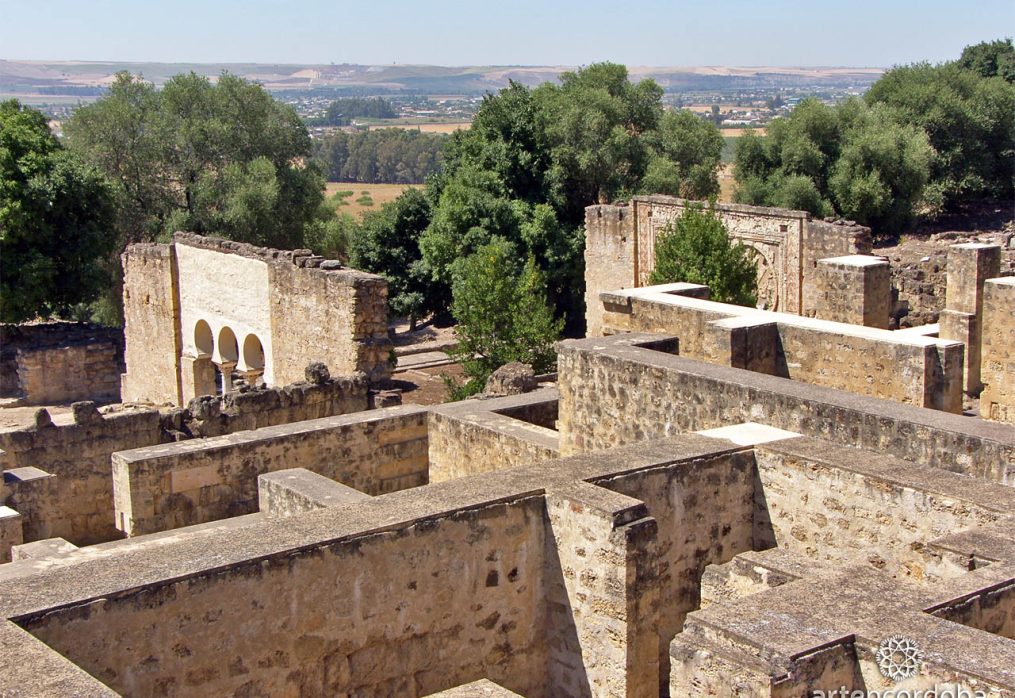
Although much of the infrastructure lies underground, on today’s route you can identify several elements:
- The pools of the Upper Garden, in front of the Salón Rico, which give an idea of the scale of ornamental water.
- The House of the Pool, with its courtyard and central pool.
- Channels, drains and sewer inspection points visible in streets and courtyards of the palace area.
- In the site museum, pieces related to fountains and water pipes.
The Valdepuentes aqueduct lies outside the visitable area, on rural land to the north, so it is not part of the usual visit. To understand what this territory looked like before the city, we recommend reading about the Sierra Morena landscape in the 10th century.
Frequently asked questions about the Medina Azahara water system
Where did Medina Azahara get its water from?
The water came from springs in the Sierra Morena and reached the city through the Valdepuentes aqueduct, an old Roman aqueduct that Abd al-Rahman III’s engineers restored and diverted towards the new palace city. The entire route worked by gravity, without pumps or waterwheels, taking advantage of the natural slope of the land.
Can you visit the Valdepuentes aqueduct?
The aqueduct is not part of the route of the Archaeological Site, as it lies outside the enclosure on rural land to the north. Some sections and the bridge over the Bejarano stream can be seen from mountain tracks, but check access beforehand, because part of the route crosses private estates.
Did Medina Azahara have sewers?
Yes. The city had an extensive network of stone sewers under streets and houses that drained waste water and rainwater down the slope. Many homes had latrines connected to this network, something exceptional in 10th-century Europe and proof of the high technical level of caliphal Córdoba.
What were the pools of Medina Azahara used for?
The pools served several purposes at once: they stored water to irrigate the gardens, cooled the air in the hot months and, above all, had a symbolic role. Their surfaces reflected the façades of the halls and reinforced the image of abundance and power that the caliph wanted to convey to his visitors.
Discover the caliph’s water with a guide
Many of these details go unnoticed if you explore the site on your own. Take a look at the best guided tours of Medina Azahara and let an expert point out the pools, channels and sewers so you understand how the caliph’s city really worked.


